Outer Banks septic guide
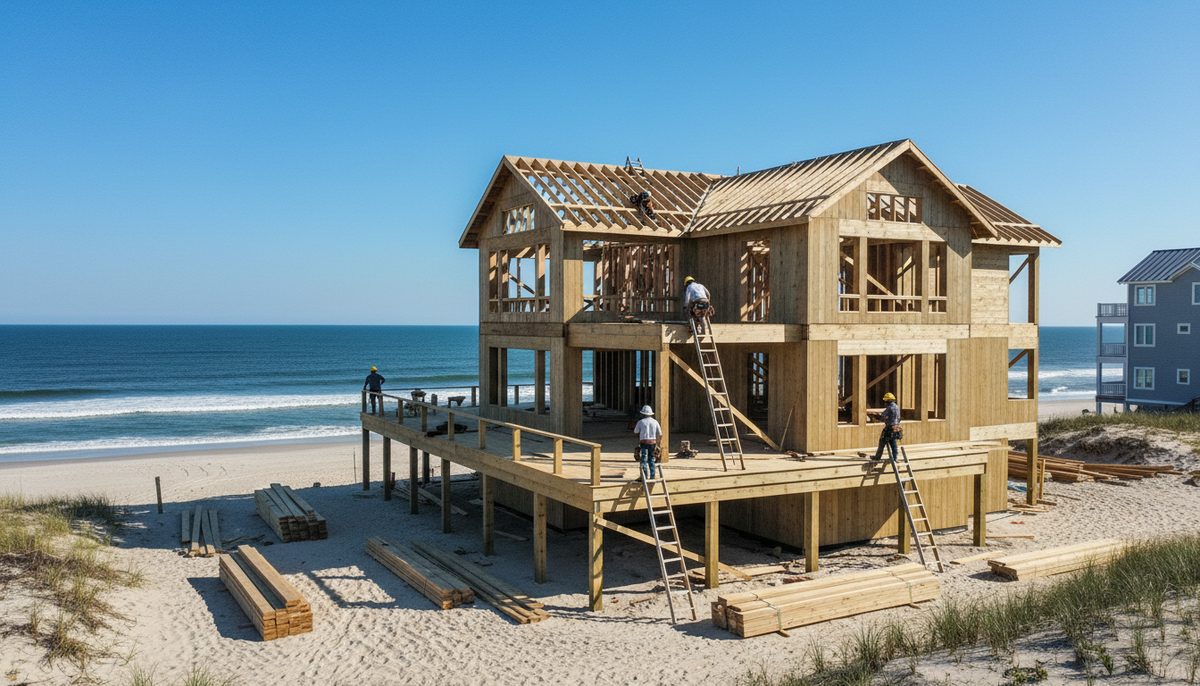
Building a home in an Ocean Hazard AEC
An Ocean Hazard AEC designation adds a signature step — the AEC Hazard Notice — on top of erosion-driven setbacks, because the state treats the dynamic oceanfront as a design condition, not scenery.
An Ocean Hazard AEC is the state's way of drawing a line around the part of this coast that moves. Inside that line the beach is understood as a process — erosion, overwash, migrating inlets — and your project is understood as something that has to coexist with the process. The designation does not forbid building. It changes the paperwork, the siting math, and the mindset, in that order.
The details
The paperwork change is small, specific, and easy to overlook in a stack of drawings: AEC Hazard Notice in Ocean Hazard areas — a project located in an Ocean Hazard AEC must obtain an AEC Hazard Notice from the Local Permit Officer in addition to the CAMA minor permit application. It is a document you sign acknowledging the hazard, and its function is exactly what it looks like: the state wants the person building on the dynamic shoreline, on the record, to have accepted that the shoreline is dynamic.
The siting math is the bigger change, and it is driven by the same geography the notice acknowledges. Inside the ocean-hazard area the setback rules run at full strength: Oceanfront setback: 60 ft or 30x erosion rate puts a new structure under 5,000 square feet at least sixty feet landward of the first line of stable natural vegetation, or thirty times the local erosion-rate factor — whichever the beach demands. The buildable envelope on an ocean-hazard lot is computed, not assumed, and it shrinks or grows with the measured shoreline behind it.
The design condition is the reason all of it exists. OBX erosion and overwash context — the islands here are shaped by erosion, accretion, overwash, and migrating inlets, and NCpedia records shoreline dredging, storm damage, flooding, and highway repairs as ongoing challenges. That is not a warning label; it is the engineering brief. A house in an Ocean Hazard AEC spends its life on a lot the ocean is actively rearranging, and the siting, the elevation, and the foundation are all answering that fact.
Practically, the sequence for an ocean-hazard lot runs: map check to confirm the designation, vegetation-line setback calculation with the local factor, the Hazard Notice signed with the Local Permit Officer, then the minor permit application with the building permit behind it. None of the steps is exotic; all of them are mandatory, and the order is not optional either. Bring us the lot and we will tell you which steps it owes — before the plan, not after the deadline.
The AEC is not a veto — it is the state pricing the ocean into your project. Sign its notice, respect its setbacks, and design for the beach you actually have.
On the record: AEC Hazard Notice in Ocean Hazard areas (NC DEQ DCM — Minor Permit Applications (deq.nc.gov, retrieved 2026-09-17)) · Oceanfront setback: 60 ft or 30x erosion rate (NC DEQ DCM — Oceanfront Construction Setback & Erosion Rates (deq.nc.gov, retrieved 2026-09-17)) · OBX erosion and overwash context (NCpedia — "Outer Banks" (ncpedia.org, retrieved 2026-09-17)) · GC licence required at $40,000+ (North Carolina General Assembly — N.C.G.S. 87-1, 'General contractor' defined; exceptions (ncleg.gov, retrieved 2026-09-17))
Hand-verified 2026-09-17 against the primary sources named above; where a fact could not be verified it was left out, never guessed.