Pricing guide
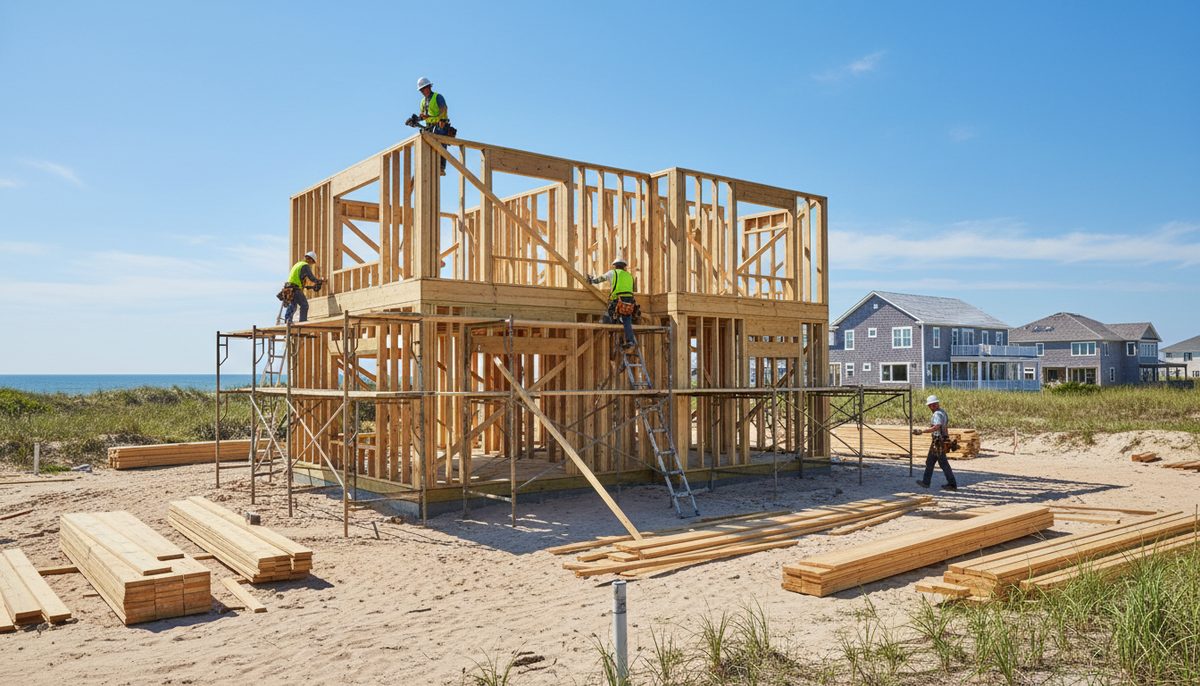
How much can a project cost before you need a licensed general contractor?
For an Outer Banks home the $40,000 general-contractor threshold of G.S. 87-1 is never in doubt — so what the line actually does is decide who is allowed to build, and what the licence protects.
The one number North Carolina printed in statute
Ask what a project may cost before the law insists on a licensed general contractor and North Carolina gives you a number you can read for yourself: GC licence required at $40,000+. The statute says that anyone who undertakes to bid on, construct, or manage the construction of any building where the cost of the undertaking is forty thousand dollars or more is deemed a general contractor — and a general contractor in this state must hold a licence from the licensing board before the first stake is set. The line is not a rule of thumb, not a lender's requirement, and not a county preference. It is Chapter 87 of the General Statutes.
What makes this question different for a house than for a fence, a deck, or a small repair is that the answer is never close. A new home on this coast — pilings, framing, roof, windows, mechanicals, finishes — is a six-figure undertaking in any honest accounting, which means a whole-house build crosses the statutory line before the drawings leave the table. So the useful question is not whether your project triggers the threshold. It is what the threshold does once it has been triggered, and that is what the rest of this page is about.
The board behind the licence
A licence number is only as good as the authority that stands behind it, and in North Carolina that authority is old, specific, and reachable. NCLBGC is the licensing authority — the North Carolina Licensing Board for General Contractors, created by the General Assembly in 1925, licenses and disciplines general contractors statewide. Two words in that sentence do the real work. Licenses means the board is the reason a builder's credential means anything at all: it is issued, tracked, and verifiable before you sign anything. Disciplines means the licence is not a one-time exam fee; it is an ongoing accountability that can be brought to bear on the person who did the work when something goes wrong.
That accountability is what the threshold is buying. Below forty thousand dollars the state treats a project as small enough to police after the fact; above it, the state wants a named, licensed, board-answerable individual standing behind the construction before it starts. When you check a builder's licence with the board before a deposit — which takes minutes — you are using the exact mechanism the 1925 legislature built for exactly this moment.
What the forty thousand actually measures
The statute counts the undertaking, not the invoice, and the distinction matters more on a house than on any smaller project. The cost of the undertaking means everything required to complete the improvement: the foundation and the framing package, windows and doors, roofing, mechanical systems, the well or the site utilities, the driveway, the finish work, and the labour for every trade that touches it — summed once, as one project, before anyone asks about licensing. A custom home does not approach that figure; it starts above it.
Two consequences follow. First, the arithmetic is not a billing puzzle. A project directed as one build is one undertaking whatever the paperwork calls it, and a licensing board that suspects a split has a straightforward question: was this one house under one direction? Second, the number is a floor on supervision, not a ceiling on anything. Crossing it does not change what may be built; it changes who is permitted to build it — and on a barrier island, where the structure has to answer to wind, water, and a moving shoreline, that distinction is the whole ballgame.
The one door around it, and what it demands
The statute contains exactly one exemption a private person building a private home will ever reach for, and it is written for the owner, not the budget. Owner-builder exemption covers a person who builds or alters a building on land they own, provided the building is intended solely for occupancy by that owner and their family or corporation. That word solely is the load-bearing one, and the statute enforces it with a presumption rather than a polite request: if the owner is not occupying the building for at least twelve months after completion, the intent is presumed absent.
On this beach, that presumption is the trap. A county where a large share of the housing stock exists to be rented is a county where the owner-builder exemption and the business plan sit in permanent tension — the house that 'saved the licence fee' and entered the summer rental calendar the following June are two facts that cannot both be true. The honest reading is simple: the exemption belongs to the person genuinely building their own residence to live in it, and it is not a cost-saving strategy for a rental or a build for someone else.
What we will not print, and how to get a real number
You will notice this page does not tell you what an Outer Banks home costs per square foot. That is deliberate. No regulator, no dated authority, and no verifiable source publishes current OBX build pricing, and a range we invented would fail you worse than silence — it would anchor a budget to nothing. What we can tell you is which statutory lines shape the price of any build here: the licensing threshold above, the coastal permitting layer a waterfront or near-water lot must clear, and the elevation standards that determine how the foundation is built before a single wall goes up.
The real number for your project comes out of your lot and your programme, and it is produced the only way honest numbers are produced: a site walk, a scope, a set of allowances, and a fixed quotation written after someone has stood on the ground. That conversation is free, and it is the one worth having. What we will tell you in the first five minutes is which side of the statutory line your project sits on — for a new house, the answer is settled — and what the licence standing behind the work is worth to you as the person paying for it.
Tell us what you want to build and where the lot sits — we will walk it, put a real number on it, and show you the licence that stands behind every dollar of the work.
On the record: GC licence required at $40,000+ (North Carolina General Assembly — N.C.G.S. 87-1, 'General contractor' defined; exceptions (ncleg.gov, retrieved 2026-09-17)) · NCLBGC is the licensing authority (NCLBGC — Laws & Regulations page (nclbgc.org, retrieved 2026-09-17)) · Dare County local elevation standard (Dare County, NC — Build Responsibly, Local Elevation Standards (darenc.gov, retrieved 2026-09-17))
Hand-verified 2026-09-17 against the primary sources named above; where a fact could not be verified it was left out, never guessed.